


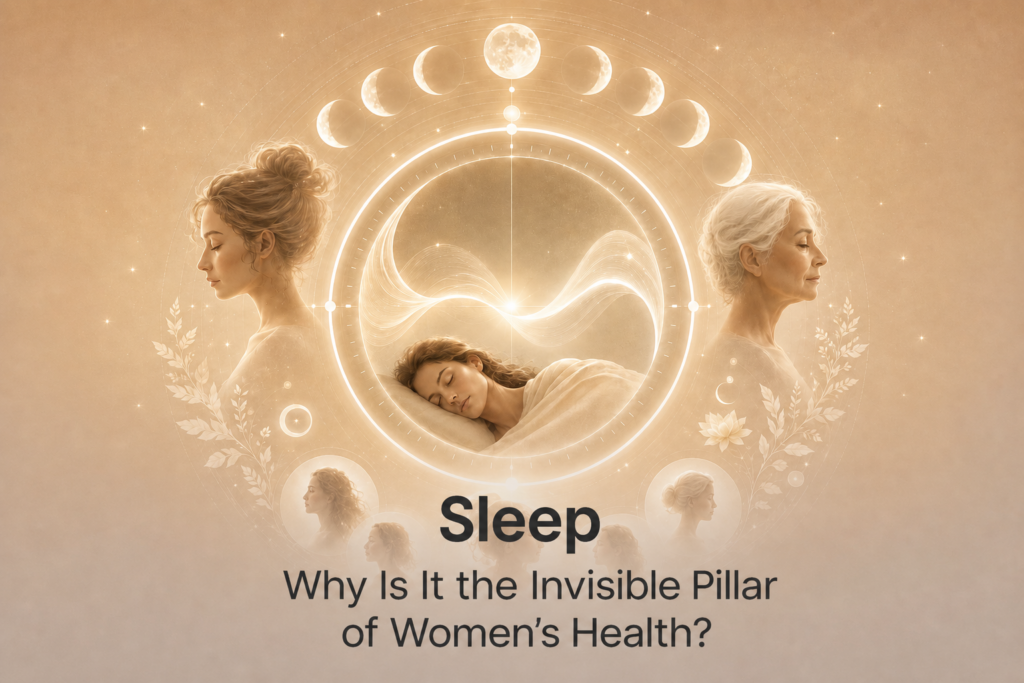
Sleep is not only a time of rest. It is a biological process in which hormones, metabolism, immunity, and the brain are rebalanced — and in that sense one of the most invisible determinants of women’s health.
Summary
Sleep is one of the invisible regulators that connect women’s biology together. At night, hormonal balance, blood sugar control, appetite, and mood are recalibrated. That is why when sleep is disrupted, the effect is not confined to a single night; it spreads across a wide field, from insulin resistance to menstrual regularity, from menopause to PCOS.
In this article
- Why is sleep not just about resting?
- How does lack of sleep affect women’s health?
- Why does sleep change in menopause?
- Why does sleep matter in PCOS?
- What can you do for better sleep?
- When does sleep call for a specialist assessment?
Sleep is most often associated only with rest. Yet in women’s biology, sleep is an active process in which hormones, metabolism, the immune system, and the brain are rebalanced together.
Women’s biology is made up of cycles that change across a lifetime. Sleep is one of the invisible regulators that quietly connect these cycles to one another. That is where sleep’s role as an unseen pillar comes from; it usually goes unnoticed, yet the systems built on it depend on it. Good sleep therefore means preparation not only for the next day but for long-term women’s health.
Why is sleep not just about resting?
Sleep is not a gap in which the body passively shuts down. On the contrary, through the night the brain and body go through an active process of repair. In the deep sleep phase, tissues are renewed, immunity is strengthened, and the metabolic load built up during the day is cleared. In the rapid eye movement phase (REM), memory is consolidated and emotions are regulated.
Sleep is the time when the body repairs itself. This repair does not only relieve tiredness; it also recalibrates hormone release, blood sugar balance, and appetite signals. Growth hormone, the sleep hormone (melatonin), and the stress hormone (cortisol) work according to a particular nighttime rhythm. When that rhythm is disrupted, the effect is not confined to a single organ.
Meanwhile the brain enters a maintenance period of its own. Research shows that the waste molecules accumulated during the day are cleared more rapidly through the night. In other words, sleep is when the brain prepares for the next day. In this respect sleep is not a single function but the sum of several tasks running at once. Through the night these phases follow one another in repeating cycles, and each cycle meets a different need.
That is why sleep carries a meaning beyond daytime performance. A good day most often begins the night before.
How does lack of sleep affect women’s health?
Sleep’s role in women’s health does not depend on a single system. When the night is disrupted, many interconnected regulators are affected at once.
The first to be affected is blood sugar balance. Insufficient sleep weakens the cells’ response to insulin and increases insulin resistance. At the same time it unbalances the hunger and satiety hormones (ghrelin and leptin); the hunger signal grows stronger and the satiety signal weaker. The next day, cravings for sweets and carbohydrates become pronounced. This is not about willpower; it is biological. The brain tries to close the energy gap with fast sugar.
The stress hormone (cortisol) is affected by this picture too. Cortisol, which should normally fall in the evening, can stay high when sleep is disrupted. High cortisol further disrupts both sleep and blood sugar, and so a vicious cycle sets in.
Reproductive hormones are part of this cycle as well. Sleep and the biological clock (the circadian rhythm) affect the release of the hormones that govern ovulation. Irregular sleep can contribute to fluctuations in menstrual regularity. Estrogen and progesterone, in turn, directly affect sleep quality; the relationship therefore runs both ways.
Finally, ongoing sleeplessness prepares a ground of low-grade inflammation. This ground strains both metabolic and hormonal balance. The effect of a single night may seem small; but when repeated, these systems stack up and accumulate. Over the years, that accumulation can also influence the long-term course of women’s health. It is precisely this quiet accumulation that makes sleep important for longevity.
Why does sleep change in menopause?
Menopause is one of the periods in which sleep changes most markedly. There is no single reason for this; several factors come together.
The foremost factor is the hormonal transition. Falling levels of estrogen and progesterone make it harder to fall asleep and to stay asleep. Added to this are night sweats and hot flashes (vasomotor symptoms). Many women wake in the second half of the night, most often between 3:00 and 5:00 a.m.
The most frequently voiced complaints are clear: waking up sweating at night, being unable to fall asleep, waking early, and getting up tired in the morning are the main ones. The problem often begins with a single trigger; the first thing that wakes you may be a hot flash. But over time, the anxiety of not being able to sleep becomes a factor that disrupts sleep in its own right. The bed stops being a place of rest and becomes a place associated with the thought “I won’t be able to sleep”; this is called learned insomnia.
There is an important distinction at this point. Sleep problems in menopause are not resolved by good habits alone; the underlying root cause needs to be identified. In chronic insomnia, the cognitive behavioral approach to sleep (CBT-I) is a structured framework accepted worldwide as the first-line option.
Why does sleep matter in PCOS?
In polycystic ovary syndrome (PCOS), sleep is a link that is often overlooked. Yet the relationship between sleep and PCOS runs both ways; disrupted sleep worsens PCOS symptoms, and PCOS itself disrupts sleep.
At the center of this cycle are insulin and the male hormones (androgens). Insufficient sleep increases insulin resistance. Rising insulin raises androgen production. Rising androgen, in turn, makes symptoms such as excess hair growth, acne, and irregular periods more pronounced; it also further lowers sleep quality, and the cycle feeds itself.
Another matter to watch for in PCOS is the pausing of breathing during sleep (sleep apnea). An excess of androgen can affect the upper airways. For this reason sleep apnea occurs not only in people who are overweight but in slim women too. Snoring, breathing stopping at night, and waking unrested in the morning are important signs. When this picture is addressed, hormonal balance often improves markedly as well.
The effects of fatigue are not limited to the body either. When sleep is disrupted, motivation falls, the threshold for stress drops, and mood fluctuates. These are not a weakness but a consequence of biology.
That is why not every sleep problem is the same. General sleep problems are often temporary and improve with behavioral habits. In PCOS, the picture is hormonal in origin and can be more persistent; alongside behavioral approaches, a medical assessment may therefore also be needed.
What can you do for better sleep?
There are a few basic principles that can be applied in daily life to support sleep. On their own they do not resolve every problem; but they establish a healthy foundation.
Starting the day with light regulates the biological clock; getting natural light in the morning is helpful. Getting up at the same time every day is one of the most powerful habits for stabilizing the sleep rhythm. In the evening hours, easing the body into a “descent mode” and reducing bright light and stimulating screens makes the transition to sleep easier. Keeping the bedroom cool and dark makes a difference, especially for women with night sweats.
One further point is not to fight it in bed once you wake. Lying awake in bed for long stretches makes the mind associate the bed with sleeplessness. The structured form of these principles is the basis of the cognitive behavioral approach to sleep (CBT-I) used in chronic insomnia.
Some daytime habits affect the night as well. Caffeine taken in the afternoon, heavy meals eaten late in the evening, and intense activity late at night can all make sleep harder. Noticing these triggers and pulling them back often makes a marked difference in sleep quality. These suggestions may not give the same result for everyone; but they form the foundation of a healthy basis for sleep.
When does sleep call for a specialist assessment?
Good habits help with most sleep problems. Some situations, however, call for a separate assessment.
Snoring, breathing stopping at night, and waking with a morning headache are signs to watch for in terms of sleep apnea. Discomfort in the legs and a constant need to move them bring to mind conditions such as restless legs or iron deficiency. Marked symptoms of anxiety or low mood call for the mood axis to be addressed alongside.
Another important criterion is duration. Insomnia experienced three or more nights a week and lasting longer than three months is assessed separately as a chronic picture. If it persists despite good habits, it is worth investigating the underlying cause. An early assessment can help protect both sleep quality and the hormonal and metabolic balance that depends on it.
Women’s health is most often described through hormones. Yet the time when hormones work most intensively is at night. A good night’s sleep is therefore not only preparation for the next day; it is a biological investment in long-term women’s health.
In the Women’s Longevity approach, sleep is not a lifestyle habit considered on its own. It is one of the fundamental processes that allow the systems making up women’s biology to work together. Assessing sleep quality is therefore an important part of understanding not only the night, but women’s health as a whole across the different stages of life.
Frequently Asked Questions About Sleep and Women’s Health
Does sleep affect women’s hormones?
Yes. Sleep and the biological clock affect the release of reproductive hormones and the estrogen–progesterone balance. The relationship runs both ways; hormonal changes also alter sleep quality.
Why is sleep different in women than in men?
In women, sleep is more affected by cyclical hormonal changes. Transitions such as the menstrual cycle, pregnancy, and menopause can alter sleep quality. Sleep problems can therefore occur more often and in different forms in women.
Does sleeplessness cause weight gain?
Insufficient sleep unbalances the hunger and satiety hormones and increases insulin resistance. Carbohydrate cravings can rise the next day. This is one of the factors that make weight balance harder to maintain over the long term.
Does sleep affect insulin resistance?
Yes. Short and broken sleep weakens the cells’ response to insulin. This makes blood sugar control harder and contributes to insulin resistance.
How many hours of sleep are enough for women?
For most adults, about seven to nine hours a night is recommended. But the quality and regularity of sleep matter as much as its length. Long but broken sleep can be less restorative than shorter, uninterrupted sleep.
Can waking at 3:00 a.m. be a sign of menopause?
It can. Waking in the second half of the night, most often between 3:00 and 5:00 a.m., is common during the menopausal transition. Hormonal change and night sweats play a part in these awakenings.
Does lack of sleep increase menopause symptoms?
Yes. Insufficient sleep can make symptoms such as hot flashes and mood swings more pronounced. Sleep and menopause symptoms can form a cycle that feeds itself.
Does sleep apnea occur in women?
Yes. Sleep apnea does not occur only in people who are overweight; because of hormonal factors, it can also appear in slim women. Snoring and waking unrested are important signs.
Does the menstrual cycle affect sleep?
Yes. The rise in progesterone in the second half of the cycle and the fluctuation of hormones in the premenstrual period can alter sleep quality. Some women wake more often during this time.
Does a melatonin supplement help with sleep?
Melatonin is a hormone that regulates the biological clock. Its use as a supplement does not give the same result in everyone; timing and dose matter. The decision to use it therefore requires individual assessment.
Sleep takes on meaning in women’s health when it is addressed not as a single night but as a process.
When hormonal balance, metabolic markers, and the rhythm of daily life are assessed together in this process, a sustainable approach becomes possible.
Content that addresses sleep and women’s biology within this holistic, scientific framework can be found through the Women’s Longevity Newsletter.
Reviewed by the LaraHealth Scientific Board.
Legal note
This content has been prepared for general informational purposes. The information it contains is not intended for diagnosis or treatment and is not a substitute for individual medical assessment. For decisions concerning your health, you are strongly advised to consult your doctor and obtain a personalized assessment.