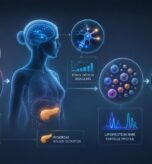




Cholesterol can be a risk for the heart; for the brain, it is an indispensable building block.
Summary
Even when blood cholesterol is normal, the brain’s cholesterol balance can work differently. The brain produces most of its own cholesterol and, because of the blood-brain barrier, manages it independently of the circulation. That is why a standard cholesterol test does not, on its own, reflect brain health.
In this article
Why do memory lapses and brain fog increase in menopause? The role of cholesterol
- What is brain cholesterol?
- Does cholesterol in the blood reach the brain?
- How is cholesterol produced in the brain?
- What is desmosterol, and how does it reveal brain cholesterol production?
- Why does brain cholesterol change slowly?
- How is excess cholesterol cleared from the brain?
- How does ApoE affect brain cholesterol and Alzheimer’s risk?
- Why doesn’t a cholesterol test fully show brain health?
Cholesterol is most often associated with cardiovascular risk; yet seen from the brain’s perspective, the story changes entirely. The human brain is one of the organs with the highest cholesterol density in the body, and about a quarter of the body’s total cholesterol is found here.
Most of this cholesterol is produced not by the circulation but directly by the brain tissue’s own cells. That is why a normal result on a standard cholesterol test does not, on its own, give enough information about the brain’s cholesterol balance.
Today cholesterol is mostly considered through the lens of cardiovascular risk. Yet from a neurobiological standpoint, cholesterol is not just a risk factor; it is a fundamental molecule that maintains the structural and functional integrity of the nervous system.
What is brain cholesterol?
Brain cholesterol is a fundamental lipid component that stabilizes the membrane structure of nerve cells, makes cell-to-cell communication possible, and supports the formation of synaptic connections. Processes such as the fluidity of cell membranes, the positioning of receptors, and the release of neurotransmitters depend directly on the presence of cholesterol.
That is why cholesterol is not only a structural element for the brain; it is also a functional regulator. Processes such as learning, memory formation, and synaptic plasticity cannot be sustained without a healthy distribution of cholesterol.
Does cholesterol in the blood reach the brain?
Cholesterol in the blood does not reach the brain directly; this reveals one of the most fundamental distinctions in brain biology. The brain is surrounded by a selective protection system called the blood-brain barrier. This barrier prevents large molecules and lipoproteins in the circulation from passing uncontrolled into brain tissue; cholesterol carriers such as LDL and HDL cannot cross it.
This distinction has a critical consequence for assessment. A lipid panel that looks “normal” cardiometabolically does not offer the same assurance neurologically. Diet, exercise, or medication can affect cholesterol in the circulation; but the production and use of cholesterol within the brain are largely independent.
How is cholesterol produced in the brain?
At the center of brain cholesterol production are astrocytes, the brain’s support cells. These cells are not merely supporting structures; they are also the metabolic regulators of the neuronal environment. Astrocytes synthesize cholesterol and carry it to neurons through particles containing ApoE (apolipoprotein E).
Neurons, for their part, do not produce cholesterol on their own; they therefore depend on the cholesterol that comes from astrocytes. This dependence makes the system efficient but also fragile; a disruption at any point in the chain of production, transport, or use directly affects synaptic functions.
The process can be summarized as a simple but critical flow: astrocytes produce, ApoE transports, neurons use. The continuity of this flow is decisive for the sustainability of brain functions.
What is desmosterol, and how does it reveal brain cholesterol production?
Cholesterol synthesis is a multi-step biochemical process. In this process, desmosterol is one of the last intermediate molecules before conversion into cholesterol. But the importance of this molecule is not limited to its position in the synthesis chain.
Desmosterol is regarded as a biological marker showing that active cholesterol production is under way within the cell. Especially during periods of intense synaptic remodeling, a rise in desmosterol levels indicates that the brain is undergoing active structural transformation. In this respect, desmosterol is a signal that points to the dynamic nature of brain cholesterol metabolism.
Why does brain cholesterol change slowly?
While the cholesterol pool in the blood can change within days, brain cholesterol is renewed far more slowly; this process takes place over months and years. The main reason is that nerve cells need structural stability. For the continuity of synaptic networks and the preservation of neuronal communication, rapid lipid changes are not tolerated.
This biological feature points to an important reality: disruptions in brain cholesterol balance develop not suddenly but gradually, and can progress unnoticed for a long time.
How is excess cholesterol cleared from the brain?
The brain cannot release cholesterol directly into the circulation; instead it uses a special conversion mechanism. The enzyme that clears cholesterol from the brain (CYP46A1) converts cholesterol into 24S-hydroxycholesterol, a form that can cross the blood-brain barrier; this molecule is then metabolized in the liver.
This process is critical for maintaining brain cholesterol balance, because a healthy system is sustained not only by production but by an effective clearance capacity.
How does ApoE affect brain cholesterol and Alzheimer’s risk?
ApoE lies at the center of brain cholesterol transport and, at the same time, has one of the strongest genetic links to Alzheimer’s disease. The APOE4 variant in particular carries out cholesterol transport and neuronal repair processes with lower efficiency.
This can lead to reduced synaptic resilience and to a biological ground more open to neurodegenerative processes. That is why brain cholesterol metabolism is regarded as one of the fundamental components of Alzheimer’s biology.
Why do memory lapses and brain fog increase in menopause? The role of cholesterol
Absent-mindedness and the hazy, slowed thinking described as “brain fog” are common in menopause; part of what underlies this experience is the change in brain cholesterol balance. Estrogen is an important hormone that regulates the distribution of cholesterol within the brain, neuronal energy use, and synaptic functions.
The fall in estrogen with menopause is, for the brain, not only a hormonal change but also a metabolic reorganization. In this process, lipid balance, synaptic structure, and neuronal repair capacity are affected; the temporary difficulties in memory and attention are often a reflection of this reorganization. That is why the post-menopausal period is regarded as a critical biological stage for brain health.
Why doesn’t a cholesterol test fully show brain health?
A standard cholesterol test measures lipids in the circulation; it does not directly assess brain cholesterol metabolism. That is why an important part of brain health remains invisible on this test:
cholesterol production within the brain
ApoE-mediated transport mechanisms
hormonal regulatory effects
inflammatory and metabolic stress
Understanding brain health therefore requires not a single parameter but the assessment of interconnected systems together.
Frequently Asked Questions About Brain Cholesterol
Is a normal cholesterol test enough for brain health?
Blood cholesterol and brain cholesterol are separate systems. The brain produces its own cholesterol and, because of the blood-brain barrier, manages it independently of the circulation. That is why a normal lipid panel is not, on its own, a sufficient indicator neurologically.
Do cholesterol-lowering drugs such as statins affect brain cholesterol?
Measures that affect cholesterol in the circulation have a limited effect on the brain’s internal production and use, because these processes work largely independently. Decisions on this matter require individual assessment.
How is brain cholesterol metabolism assessed?
A standard panel does not directly show brain cholesterol. In research, markers such as desmosterol and 24S-hydroxycholesterol are used to follow the dynamics of brain cholesterol production and clearance.
Brain health takes on meaning when it is understood not as a single measurement but as a biological direction that unfolds over time.
Assessing this process correctly requires going beyond circulating lipids to consider brain cholesterol metabolism, hormonal transitions, and inflammatory burden together.
Content that addresses brain health and women’s biology within this holistic, scientific framework can be found through the Women’s Longevity Newsletter.
Reviewed by the LaraHealth Scientific Board.
Legal note
This content has been prepared for general informational purposes. The information it contains is not intended for diagnosis or treatment and is not a substitute for individual medical assessment. For decisions concerning your health, you are strongly advised to consult your doctor and obtain a personalized assessment.