



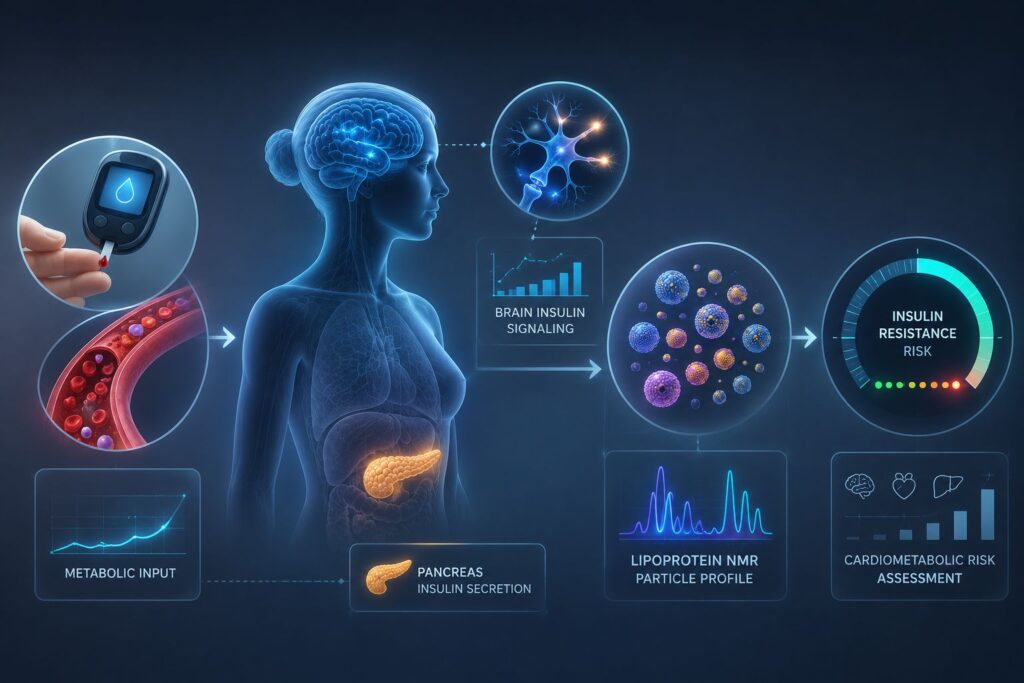
Routine laboratory results may appear normal. Fasting blood glucose can fall within the reference range, and long-term glycemic markers such as HbA1c may remain stable. Yet metabolic disease often begins long before these conventional markers become abnormal.
Insulin signaling can gradually deteriorate 10 to 20 years before Type 2 diabetes becomes clinically apparent. During this early phase, cells become less responsive to insulin; skeletal muscle takes up less glucose, the liver continues producing glucose despite insulin signaling, and fatty acids that should be stored in adipose tissue begin circulating in the bloodstream.
Throughout this process, blood glucose levels often remain normal. This is because the pancreas compensates by increasing insulin production. However, this compensatory mechanism is not sustainable indefinitely. A metabolic shift has already begun, even though conventional tests may not yet detect it.
This is why many individuals wonder: Can I have insulin resistance even if my blood sugar is normal?
Developed to help answer this question, the Lipoprotein Insulin Resistance Score (LP-IR) is one of the most predictive biomarkers for identifying metabolic risk before it becomes clinically visible.
What Does the LP-IR Score Measure?
Standard cholesterol tests measure LDL cholesterol, HDL cholesterol, and triglyceride levels. However, these values only quantify lipoproteins; they do not assess the structural characteristics that are often more important from a metabolic health perspective.
In the early stages of insulin resistance, increased free fatty acid flux to the liver stimulates triglyceride production. This leads to both an increase in the number and size of VLDL particles. As VLDL rises, LDL particles become smaller and denser, while HDL particles lose some of their functional capacity.
This pattern is known as atherogenic dyslipidemia, a hallmark of early metabolic dysfunction.
Using Nuclear Magnetic Resonance (NMR) spectroscopy, the LP-IR test evaluates six key lipoprotein parameters:
- Large VLDL particle concentration
- Mean VLDL particle size
- Mean LDL particle size
- Small LDL particle concentration
- Large HDL particle concentration
- Mean HDL particle size
These six measurements are combined into a single score ranging from 0 to 100, where 0 represents optimal insulin sensitivity and 100 represents the highest degree of insulin resistance. Clinical studies have associated scores above approximately 45–48 with increased metabolic risk.
Why Is LP-IR More Reliable Than Fasting Insulin?
Fasting insulin is commonly used to assess insulin resistance. However, it reflects only a single point in time and is highly influenced by biological variability.
Sleep quality, stress levels, physical activity before testing, and hormonal fluctuations can all significantly affect fasting insulin measurements. As a result, fasting insulin often represents a snapshot rather than a stable picture of metabolic health.
The LP-IR score, by contrast, integrates multiple biomarkers into a composite metric. This makes it less susceptible to short-term fluctuations and more reflective of the body’s underlying metabolic trajectory.
More importantly, LP-IR captures alterations in lipoprotein metabolism that often emerge before glucose regulation becomes abnormal. As such, it can reveal the earliest biological signs of insulin resistance before conventional tests detect any changes.
How Many Years in Advance Can LP-IR Predict Diabetes Risk?
One of the most remarkable features of LP-IR is its predictive power.
In prospective cohort studies involving more than 29,000 women without diabetes, baseline LP-IR levels were shown to strongly predict the development of Type 2 diabetes over a 20-year follow-up period.
Elevated LP-IR scores were frequently identified even when fasting glucose and HbA1c remained within normal ranges.
These findings suggest that metabolic dysfunction begins at the level of lipoprotein metabolism before it becomes evident through conventional glucose markers. Traditional tests tend to change only after a biological threshold has been crossed, whereas LP-IR can identify the metabolic shift much earlier.
Why Is LP-IR Interpreted Differently in Heart Failure?
In the general population, elevated LP-IR scores are strongly associated with insulin resistance, metabolic syndrome, cardiovascular disease, and Type 2 diabetes.
However, a different pattern has been observed in individuals with advanced heart failure.
In this population, higher LP-IR scores have, in some studies, been associated with lower mortality rates. This phenomenon is often referred to as reverse epidemiology.
Lipoproteins are not merely lipid transport particles. They can also bind and neutralize circulating bacterial toxins such as lipopolysaccharides (LPS), potentially helping to reduce systemic inflammatory responses.
For this reason, LP-IR should not be viewed solely as a diabetes risk marker. Rather, it should be interpreted within the broader biological context of the individual patient.
Can a High LP-IR Score Be Reversed?
A high LP-IR score is not an endpoint—it is an early signal of metabolic dysfunction.
Insulin resistance is a dynamic and potentially reversible process. The balance of energy metabolism between skeletal muscle, liver, and adipose tissue can be restored through targeted interventions.
Reducing refined carbohydrates, increasing dietary fiber intake, and consuming adequate amounts of protein and healthy fats can significantly improve insulin sensitivity.
Regular physical activity, particularly resistance training and muscle-building exercise, enhances glucose uptake in muscle tissue and improves insulin signaling pathways.
Sleep optimization and stress management are equally important. Chronic sleep deprivation and elevated cortisol levels are independent contributors to insulin resistance.
Metabolic health, however, cannot be explained by a single pathway. Vitamin D status, thyroid function, inflammatory markers, and gut microbiome health should all be evaluated as part of a comprehensive assessment.
What Can a Lipoprotein Profile Tell Us About Metabolism?
Blood sugar levels may appear normal, yet the lipoprotein profile can provide insights into much earlier stages of metabolic dysfunction.
The LP-IR score offers a higher-resolution view of these early metabolic changes, enabling clinicians to identify risk years before clinical disease develops.
The more important question is often not “Are my lab values normal?” but rather “Is my metabolism truly functioning optimally?”
Insulin resistance rarely develops overnight. It is typically the result of a gradual metabolic shift occurring over many years.
At LaraHealth, LP-IR is viewed as one component of a comprehensive metabolic assessment. Rather than focusing on a single score, metabolic health is evaluated through the interaction of multiple interconnected systems—including lipoprotein metabolism, insulin signaling, hormonal regulation, inflammation, and cellular energy production.
The goal is not simply to identify risk, but to recognize and address the biological processes that disrupt metabolic balance before disease becomes established.
Frequently Asked Questions About LP-IR
Can you have insulin resistance even if your blood sugar is normal?
Yes. Insulin resistance may begin 10–20 years before the development of Type 2 diabetes. During this early stage, increased insulin secretion from the pancreas can maintain normal blood glucose levels, making conventional tests appear normal despite underlying dysfunction.
What is considered a healthy LP-IR score?
The LP-IR score ranges from 0 to 100. Lower scores indicate greater insulin sensitivity, while higher scores indicate greater insulin resistance. Clinical studies have associated scores above approximately 45–48 with increased metabolic risk.
Does LP-IR replace fasting insulin testing?
LP-IR is not a replacement but a complementary tool. Because it is less affected by short-term biological variability, it often provides a more stable representation of underlying metabolic trends than fasting insulin alone.
Metabolic health becomes meaningful when assessed not only through current laboratory values but also through the direction in which biological systems are moving.
Advanced biomarkers such as LP-IR can reveal early metabolic shifts before conventional tests become abnormal, creating an opportunity for earlier intervention and more effective risk management.
If you would like to better understand your metabolic profile and assess insulin resistance from a clinical perspective, consider scheduling a consultation with your healthcare professional. You may also subscribe to the Women’s Longevity Newsletter to receive ongoing insights into metabolic and preventive health.
Legal Disclaimer
This content is intended for educational and informational purposes only. It is not intended to diagnose, treat, cure, or prevent any disease and should not be considered a substitute for professional medical advice, diagnosis, or treatment. Always consult a qualified healthcare professional regarding any medical concerns or decisions related to your health.